

Audit-ready LCAs
in days, not quarters.
ClimatePoint turns messy product data into ISO and PEFCR aligned reports for DPP compliance, customer requests, and sustainability disclosures. Sixteen impact categories, pedigree-scored, third-party audited in-platform.
- Coverage
- 16 PEF impact categories (EF 3.1)
- Standards from one dataset
- 3 ISO standards, one run · 14040 / 14044 / 14067
- Regulatory timeline
- 2027-2030 EU DPP deadlines by sector
 EF 3.1 · ISO 14040/14044/14067 · CIRPASS-2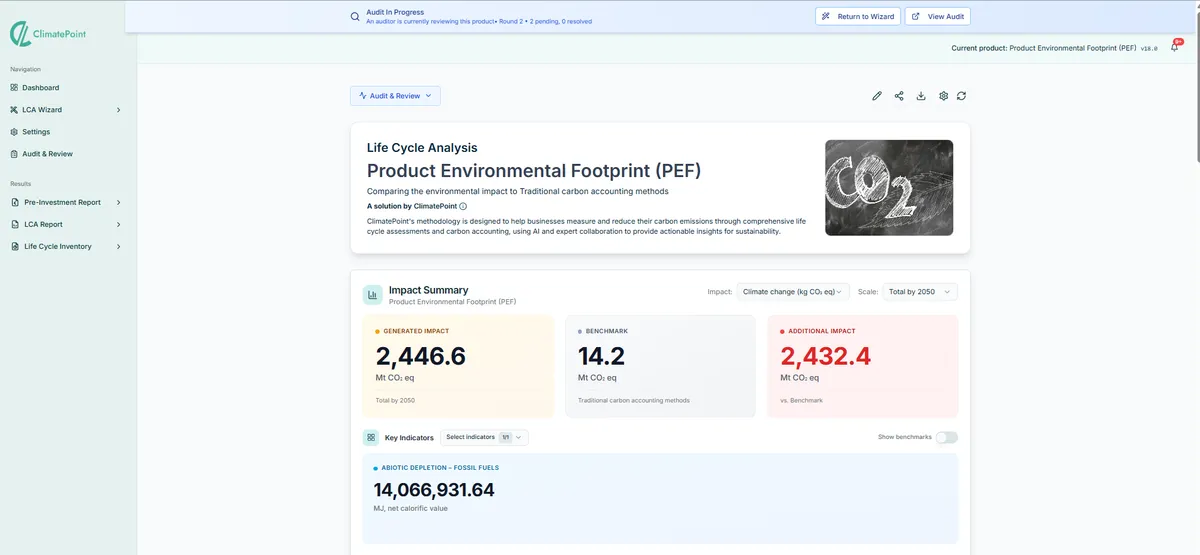






The hidden cost of chasing primary data
01 · THE BRIDGE
The data exists. The bridge doesn’t.
Your teams already capture materials, routings, transports, and energy use in the ERP. Mapping that into an LCA tool, by hand, is where eleven of your twelve weeks go.
THE REPORT · See what your auditor sees
Click through
a sample LCA Report.
Skip the sales pitch. Create a free account and open the same interactive 16-category LCA Report your auditor will sign off on, populated with a sample product so you can see the full shape of a finished assessment. Scroll, drill down, toggle lifecycle stages, compare to the category average. Then decide if you want to talk to us.
Every report tracks primary data where it matters and pedigree-scored secondary data where it does not. Every calculation is traceable to the LCI activity behind it. The raw methodology, the activity IDs, the DQ scores, and the audit trail all live in the same document.

Audit In Progress
An auditor is currently reviewing this product · Round 2 · 2 pending, 0 resolved
Life Cycle Analysis
Product Environmental Footprint (PEF)
ClimatePoint's methodology is designed to help businesses measure and reduce their carbon emissions through comprehensive life cycle assessments and carbon accounting, using AI and expert collaboration to provide accurate insights.
Sixteen, not one.
Carbon is one of sixteen PEF impact categories. We compute all of them for every report, using the EF 3.1 method. If your customer or regulator asks for anything beyond carbon, it is already there.
Quality-scored, every data point.
Every input carries the EF 3.1 data quality rating across four criteria: technological, geographical, and temporal representativeness, plus precision. You can trace every number back to its source and its uncertainty without leaving the report.
Auditor record, in the report.
Findings and resolutions from third-party auditors live inside the same document. What you publish is what was audited, not a summary of what was audited.
THE ENGINE
Built once, compliant many ways.
One engine.
Every compliance regime.
The same primary data and pedigree scores that build your PEFCR also produce ISO 14040, 14044, and 14067 reports, feed CSRD environmental disclosures, and hand off clean data to any Digital Product Passport issuer. You do the work once. Every framework you are asked for later is a report away, not a project away.
THE AUDITOR · Integrated third-party audit workflow
Your auditor is already
in the platform.
Every PEFCR, ISO 14040/44, and ISO 14067 report you produce can be reviewed, challenged, and signed off by an independent third-party auditor working inside ClimatePoint. Findings, resolutions, and approvals live alongside the data they refer to. When you hand a report to a regulator, a retailer, or a DPP issuer, you are handing them a record, not a claim.
Audit Session #A-2047
Cotton tee, 180gsm · PEFCR report · Round 2
THE PROCESS · Workflow
From bill of materials to audited PEFCR
in four steps.
Most LCA projects take twelve weeks because the first eleven are spent chasing supplier data in spreadsheets. We collapse that into days by running the collection, the calculation, and the audit on the same platform, with the same data model, from the first upload to the final handoff.
Upload your bill of materials.
Drop in a BoM from your PLM, your spreadsheet, or a supplier PDF. Our engine maps components and materials to LCI activities automatically. You review, correct, and confirm the mapping before anything is calculated.
~ 15 minutesCollect supplier data where it matters.
We push data requests to your suppliers for the lifecycle stages that drive the footprint. Everything else uses pedigree-scored EF-compliant secondary data. You do not wait for every vendor, you wait for the ones that matter.
~ 1 to 3 days (parallel)Run all 16 impact categories.
The engine computes the PEFCR output across all 16 PEF impact categories using the EF 3.1 method. Every number is traceable to the LCI activity behind it. Same data runs ISO 14040/44/67 if you need single-metric carbon alongside.
~ minutesThird-party audit and handoff.
Assign an independent auditor. They review the data, raise findings, you resolve them inline, they sign off. Export a PEFCR-compliant, audit-stamped report, or hand it to any DPP issuer via API.
~ 3 to 5 daysSTART · The next step
Ready to see it
on your own products?
Not a sales pitch. A 30-minute working session. Bring one product you would actually have to generate a PEFCR for and we will walk through the BoM live, show you what primary data we would need to collect, and give you an honest estimate of what shipping a full audit-ready PEFCR for it would actually take.
What we will actually do
No calendar tennis. Pick a slot, bring one product, show up. We send a short pre-call form so we do not waste the first five minutes on introductions.
Prefer async? Email us one product and we will come back with a written estimate.